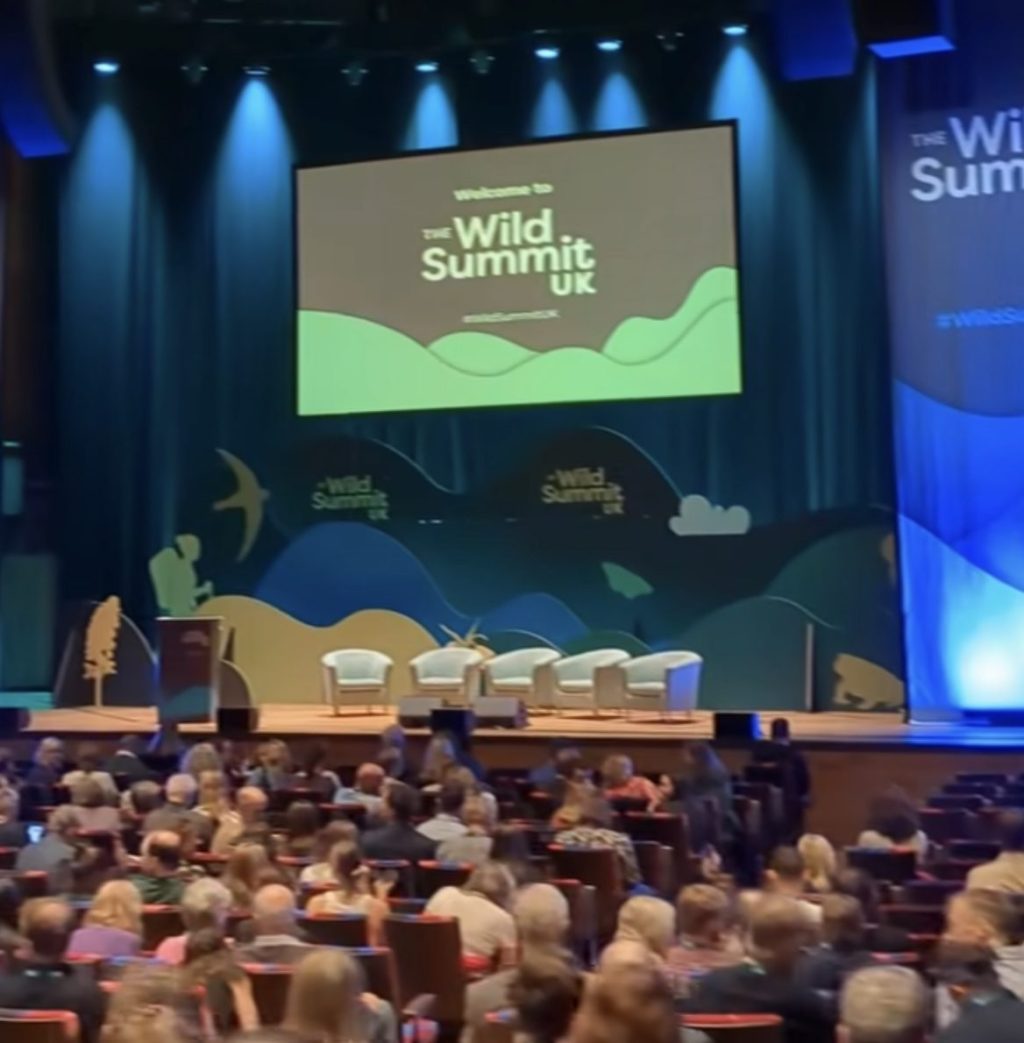
On Thursday 11 September, the first-ever Wild Summit UK took place at the Bristol Beacon. Organised by Wildlife and Countryside Link alongside more than 30 major nature organisations, the event attracted over 1,200 participants. From the moment registration opened, the atmosphere was electric: campaigners, policymakers, academics, and business leaders gathered to confront one of the UK’s biggest environmental questions – how to meet the promise of protecting 30% of land and sea by 2030 (30×30).
The crowd reflected the breadth and depth of the UK’s environmental movement, spanning grassroots campaigners to national NGOs. Throughout the day, a self-awareness surfaced around identity and unity. How can the sector define itself, celebrate its differences, and still speak with one clear, compelling voice? As many speakers stressed, the challenge is not just technical but cultural: uniting perspectives without losing their richness and turning this diversity into a formidable strength.
Ahead of the Summit, Wildlife and Countryside Link released a report assessing the UK’s progress towards the 30×30 target. It highlighted that meaningful progress would require a rapid increase in designations, proper investment in management, stronger rules to end harmful activities, and robust monitoring to track delivery.
From the stage, the Labour Government sought to show it was listening. Mary Creagh, Parliamentary Under-Secretary of State for DEFRA, announced three new measures – described as all in a “week’s work”. These included: the extension of the ban on burning deep peat (described as “our Amazon rainforests”); new legislation enabling the UK to meet its obligations under the BBNJ (Biodiversity Beyond National Jurisdiction) Agreement, establishing the first legal mechanism for marine protected areas in international waters; and a commitment to end the use of banned neonicotinoids in England to protect pollinators.
In the opening session, ‘Meeting the 2030 Challenge’, the moderator, Steph Spyro, invited the audience to rate Labour’s first year on nature. The average was low. When the panellists were asked the same question, the consensus placed the government’s performance at five out of ten. The message was clear: while announcements are welcome, the real test lies in turning positive statements into measurable action.
With Labour’s score stuck at five, the threat of political reform – and the instability it could bring – loomed large. This concern echoed a wider theme raised by Kabir Kaul: the danger of leaving people behind, particularly younger generations. “Even glaciers are moving faster than the rate of youth engagement in nature policy”, he joked. For him, the challenge lies not only in policy delivery but also in rekindling connection and optimism to sustain momentum in the years ahead.
The issue of framing emerged as a defining factor in the ‘Investing in Nature’ session. Speakers highlighted that restoring nature would require an estimated £6 billion more than current funding – a gap that public and philanthropic sources alone cannot bridge. For too long, the economy and environment have been portrayed as opposing forces, with nature protection cast as a barrier to prosperity.
Finance experts – including Professor Baroness Kathy Willis, Karen Ellis, Kerry ten Kate, Shaun Spiers, and Whitney Thomas – challenged this view, arguing that recognising nature as an economic asset can unlock major restoration investment. At the same time, they stressed the importance of honesty: framing nature only in economic terms risks side-lining its intrinsic value. A clear regulatory framework, they argued, is essential to incentivise responsible business action.
This reinforced Mary Creagh’s earlier message that “without healthy nature, our communities, our economy can’t thrive”. Yet the shadow of Rachel Reeves’ rhetoric fell across the proceedings. Her framing, described by some as a “war against nature”, was repeatedly cited as an example of how political language can hinder progress – reinforcing the idea that environmentalists are “blockers” of growth rather than builders of solutions.
Panellists agreed that the real challenge is not growth versus nature but resilience in the face of climate and ecological breakdown. The session called for nature to be embedded into the core of economic decision-making, with the cost of inactionweighed as seriously as the cost of action. Suggested priorities included mandatory disclosure of nature-related financial risks; stronger regional links between supply and demand; mobilising bottom-up action; and closer collaboration between Treasury, DBT and DEFRA.
The ‘Backing British Wildlife’ session delved deeper into how negative narratives shape public attitudes towards nature. While governments and businesses increasingly stress that ecosystems underpin the economy, media portrayals often lean on fear. Species such as bats, rats, wasps, moths, and spiders are routinely labelled as “pests” or “scary”, making them easy political targets.
Mya-Rose Craig (otherwise known as Birdgirl), observed that people often respond more to the idea of an animal than to its reality. Emma Slawinski expanded on this, describing a feedback loop between “language, shape, and perception”. By changing the language we use, she argued, we can begin to change outcomes, citing her involvement in the “Wasp Appreciation Society” as an example of reframing a maligned species.
A warning towards an “out of sight, out of mind” attitude emerged, particularly in relation to oceans. Unless blue spaces are embedded in the public imagination, their protection will continue to lag behind that of green spaces. Picking up on this point, Tony Juniper offered a practical intervention, suggesting the addition of QR codes along new coastal paths to reveal the hidden marine life of nearby protected areas.
Beyond perception, the speakers called for structural reforms. Suggestions included granting ecosystems legal representation – a rights-of-nature approach treating them as living entities standing in law – and tackling misinformation that otherwise fuels fear and suspicion. When asked what gave them hope, speakers pointed to the rise of rewilding, the mainstreaming of once-radical ideas, and the surge in youth activism.
The ‘Planning for People and Nature’ panel brought together the themes of ‘Backing British Wildlife’ and ‘Investing in Nature’ to debate how planning reform could either support or obstruct ecological recovery.
Hilary McGrady, Director General of the National Trust, opened with a call for vision – arguing that planning must be driven by long-term purpose rather than short-term politics. Guy Shrubsole agreed, warning that the current government risks treating the planning system as static rather than adaptive. He noted that around 80% of UK land lies outside the formal planning system, meaning a focus solely on development reform ignores most of the landscape.
Guy Shrubsole also highlighted issues such as land banking, which inflates prices and slows progress, while welcoming the emerging Land Use Framework as a positive step. He cited historical precedents like the National Parks and Access to the Countryside Act, alongside proposals for a Climate and Nature Bill, as examples of legislation that could reaffirm the public’s right to access and restore nature.
A recurring theme was the need to move beyond the false choice of housing versus nature – part of the wider growth versus nature dichotomy. Rosie Pearson warned against what she called the Trumpian “build, baby, build” approach used by Housing Secretary Steve Reed, and pushed back against the negativity surrounding the accusation of being a “blocker”:
There is nothing wrong with being a blocker if you’re blocking something that destroys habitats, doesn’t have sewage, doesn’t have nurses, doesn’t have schools, doesn’t have jobs. Why would you want that? We need to build the right things first.
Much of the discussion focused on the proposed Planning and Infrastructure Bill, which drew sharp criticism for its so-called “Nature Restoration Levy”. Criticism warned that it would effectively allow developers to pay a one-off fee to override long-established environmental protections – a system described by Pearson as “cash to trash” habitats. She argued that the Bill assumes nature can be “restored” through a system that lets developers pay to destroy one habitat and fund the creation of another, possibly far from the original site. Pearson also highlighted clauses allowing reduced restoration fees if a project becomes financially unviable, concluding that “nature is very much last in the Planning and Infrastructure Bill”.
A particularly loud “Well said!” rang from the audience at her remark. While Pearson welcomed July’s amendments as “a great start”, she maintained that the section “needs to go back to square one”.
While some hoped for “win–win” alignment between environment and planning goals, Guy Shrubsole cautioned against wishful thinking, arguing that real progress depends on confronting hard land-use trade-offs.
Access emerged as another central theme. Speakers agreed that connection to nature is not a privilege but a right – essential if people are to protect it. The government’s pledge to guarantee “15-minute access” to green space was widely welcomed in principle, but many questioned its feasibility alongside plans to build 1.5 million homes, particularly when developments continue to destroy nature on people’s doorsteps.
Underlying all of this was a shared conclusion: planning must be practical, not performative. A strong system should harness the public’s love for nature while giving communities the rights and tools to restore and protect it.
Earlier in the day, the ‘From Source to Sea’ panel positioned rivers as a litmus test for environmental policy – the point where farming, industry, regulation, and public health converge. Hugh Fearnley-Whittingstall set the tone:
If we can’t get rivers right, we can’t get anything right. We can’t get farming right, we can’t get food right, we can’t look after the climate, and we can’t look after our health. Rivers are where everything comes together — and where, if we get it wrong, everything will fall apart.
He highlighted the power of public pressure in defending rivers. Recent grassroots victories included the rejection of a 32,000-chicken farm on the River Kennet; River Action’s court win closing a major manure loophole; and an international precedent from Spain, where a human rights case forced action against industrial pollution. Calls for a new Water System Stewardship Authority underlined the need for a regulator mandated to prioritise the environment and public health.
Natalie Prosser, Chief Executive Officer at the Office for Environmental Protection, described water pollution as a “visceral issue”, noting that once-safe rivers and lakes have become too polluted to swim in. She called for a catchment-based approach, arguing that while the framework already exists, “it hasn’t been implemented and it’s not been complied with”.
Building on this, James Wallace, Chief Executive of River Action, declared a freshwater emergency, condemning both regulatory inaction and the failures of the privatised water model. He also challenged the myth that environmental protection competes with public health funding, emphasising that enforcing environmental law ultimately reduces healthcare costs linked to pollution.
In response, Daniel Walker-Nolan (Director of Policy, Water UK) acknowledged cultural failings within the sector but pointed to growing pressures from climate change, population growth, and rising energy demand – suggesting that reform must address both accountability and capacity.
Debate centred on whether progress depends on stronger enforcement of existing laws or systemic reform. Many noted that legislation already exists but is rarely applied: the 2018 Farming Rules for Water have never been enforced, while cases such as Thames Water’s six-year River Mole fish kill result in fines too small to deter repeat offences. Court delays of three to five years further blunt accountability.
Ultimately, rivers were framed as both a rallying point and a warning: without urgent reform, environmental damage, public health crises, and political fallout will continue to flow downstream.
With agriculture covering 70% of the UK’s land, farming also sits at the heart of climate, biodiversity, and food security debates. Yet the sector remains caught in a bind – squeezed between the demands of industrial production and the urgent need for nature-friendly reform. The ‘Farming the Future’ panel stressed that farmers must be treated as part of the solution. However, policy uncertainty, supermarket dominance, and fragile finances have left many unable to adapt, creating what the National Farmers’ Union (NFU) described as a “crisis of confidence”. As MP Toby Perkins remarked, “Nothing is more important than repairing that relationship”.
Overconsumption emerged as a defining issue, echoing debates in ‘From Source to Sea’. James Wallace declared, “It’s insane that half our grain crop is to feed animals so they can feed us. Let’s grow food that feeds us”, whilst Hugh Fearnley-Whittingstallechoed the call for people power, urging the public to start with what they eat and warning that “short-term convenience has been allowed to outweigh long-term responsibility”.
A shift toward a planetary health diet – balancing nutrition with ecological limits – was framed as both realistic and necessary in ‘Farming the Future’, with polling showing that 60% of 18-24 year olds are open to reducing meat consumption. Vicki Hird cautioned against “carbon tunnel vision”, where climate policy reduces animals to emission sources while ignoring welfare, soil, and water impacts. Efforts to speed up lifecycles to cut emissions, she warned, risk worsening animal welfare. Instead, she called for a clear national strategy to reduce meat consumption while embedding welfare in sustainability standards.
Returning to the national land use framework proposed in ‘Planning with People and Nature’, speakers explored what better land management could achieve. Hemp was highlighted as a potential game-changer: fast-growing, carbon-absorbing, and highly versatile in food, textiles, and construction. Yet uptake is blocked by licensing hurdles, high costs, and lack of processing infrastructure.
A historical case from 16th-century Sheringham was used by David Wolfe to illustrate how effective regulation can drive change. When the Navy faced a hemp shortage, legislation required farmers in Norfolk and Suffolk to grow one acre of hemp for every sixty acres of land. Fines for non-compliance were to fund the construction of a pier – yet so few were collected that the pier was never built. The story drew laughter in the room whilst simultaneously underscoring what clear, decisive policy can achieve.
The panel’s key asks for DEFRA centred on creating a more coherent and equitable framework for the future of farming. They called for long-term clarity and ambition, with the Sustainable Farming Incentive (SFI) placed at the heart of agricultural policy; a national land use framework balancing food, nature, and climate; a trust-based relationship with farmers; consideration of overseas impacts from imported food; and fairness across the supply chain so that the burden of sustainability falls on retailers, not farmers.
The final session of the day, ‘From Local to Global’, explored what role the UK can credibly play on the world stage. Matthew Gould (ZSL Chief Executive Officer), a former diplomat, argued that the UK is uniquely positioned to show leadership in nature – but only if it plays to its strengths. As an ocean nation stewarding the Blue Belt and a global financial hub capable of mobilising investment for nature, the UK holds real potential to lead by example. However, Gould cautioned that authenticity is non-negotiable: rhetoric without substance will only erode credibility.
Ruth Davis, the UK Special Representative for Nature, reinforced this point, warning that international leadership must avoid any trace of colonial paternalism. True leadership, she argued, must be rooted in partnership, community-led conservation, and environmental justice. While scientific collaboration tends to succeed because it is evidence-based and open to questioning, political leadership requires confronting harder issues of justice, equity, and power.
Closing Remarks
The Summit ended with both hope and apprehension. Many were inspired by the creativity, collaboration, and determination on display. But there was also a palpable fear that years of progress could be undone by political headwinds – especially the rise of populist, anti-nature rhetoric from Reform UK, which has pledged to scrap net zero targets, cut renewable subsidies, and revisit fracking.
Yet polling shows public opinion remains firmly on the side of nature: 80% of people in the UK support conservation. As speakers noted, nature is deeply tied to national identity – from rivers and landscapes to ancient trees – making attacks on it politically risky. The challenge is to turn this public support into political momentum as the next election cycle approaches.
Martin Harper (CEO of BirdLife International) reminded the audience that real power lies in organisation – in connecting people and institutions to turn support into leverage. He urged campaigners to be bolder and more confident, pushing harder on governments and international frameworks alike. Richard Benwell (Chief Executive of Wildlife and Countryside Link) closed the day by calling for a fusion of grassroots firepower and policymaker influence, challenging political leaders to step up and show leadership in the coming year.
If the day proved anything, it’s that restoring nature is no longer a fringe cause. It is a test of political credibility – one that will define the years to 2029 and beyond.

 Green Admissions