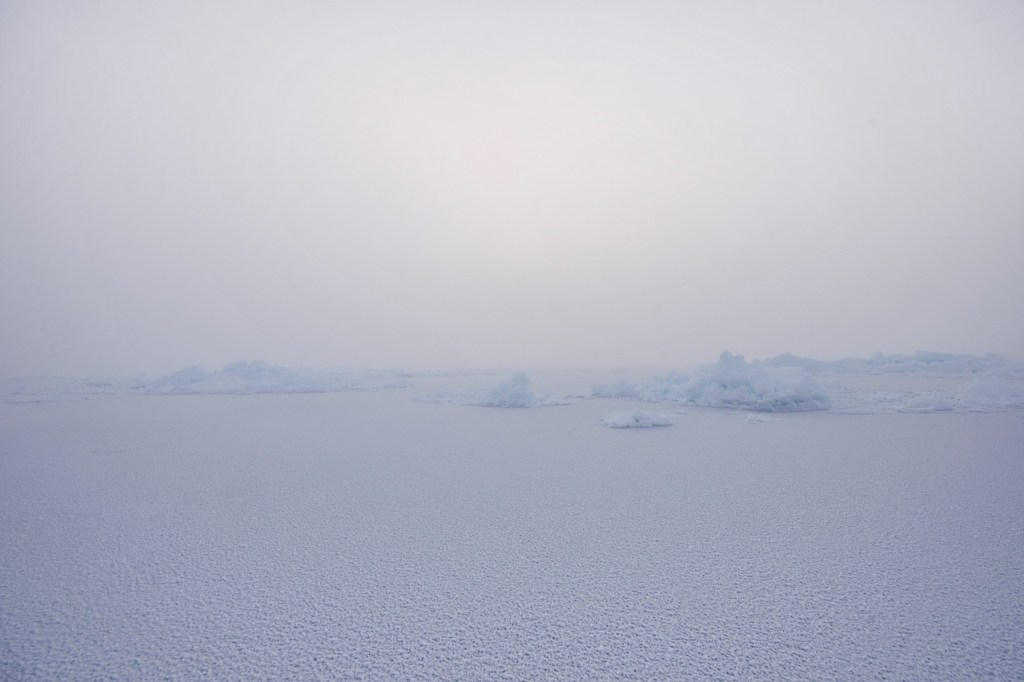
It is highly likely that most of us will never experience the Arctic or Antarctic firsthand. We may never take the long flight over apparent nothingness, step onto miles of moving ice, or sleep with one eye open as the very ground beneath us shifts and cracks through the night. Yet, as polar explorer and photographer Martin Hartley makes clear, this distance does not render the polar regions irrelevant. On the contrary, it may be precisely because so few of us will ever go there that what these places reveal about attention, presence, and connection matters so deeply now.
Celebrated by The Times as one of its “Heroes”, Martin Hartley has spent over 400 days working across both the Arctic and Antarctic. However, what he shared during his talk at the Belmont Estate event on 23rd October 2025 was not framed around heroism or conquest. Instead, it was a reflection on what extreme environments strip away, and what they leave behind.
Life in the polar regions, Hartley explains, is defined less by drama than by monotony and precarity. From day one to day thirty, almost “nothing changes”. The terrain is vast, flat, and deceptively still. Yet beneath this apparent stillness is constant movement: ice shifting miles each year, tides smashing it apart in the days surrounding a full moon, and sudden expanses of open black water plunging more than two miles deep.
Reaching these environments is itself an act of separation. A five-hour flight from South America, for instance, can cross an entire landscape without a single sign of human life. Once the plane departs, there is no rescue on demand. “You’re on your own”, Hartley explains, and the isolation becomes absolute. They are among the very few places left on Earth where this is still the case.
On an expedition, progress across the ice is uncertain. On a good day, nine miles might be covered; on a bad one, ten hours of effort can yield only a few hundred metres. Over time, these extremes balance out but only if perspective is maintained.
Rest is also precarious. Conditions inside the tent can often be worse than those outside, as snow accumulates and clouds of condensation form from breath during breakfast. Hartley recounts how, on nearly every expedition, a crack will appear in the ice beneath the tents overnight. Each night cradles the same question: “Are we going to make it through?”.
Risk, in these environments, is not something to be overcome but something that must be managed continuously. Even minor mishaps and small errors can quickly escalate into life-threatening situations. Hartley offers sweating as an example, describing it as “the fastest way to die” at minus forty degrees. Moisture, he explains, pulls heat from the body faster than anything else.
In another anecdote, Hartley recounts an expedition during which a jacket had been sewn incorrectly, with its layers reversed. In a video shown during the talk, he shows himself struggling to force the frozen garment on, mocked by teammates as he needed help getting dressed. This drew laughter from the audience, but the humour underscored something more serious: the body’s almost childlike vulnerability in these environments. He describes the shock of cold air as “like a double espresso to the system,” jolting the body into acute awareness.
Human dynamics play a critical role in risk management. Expeditions, Hartley notes, tend to work best with three people. With four, they often fracture into two-versus-two dynamics as competing agendas emerge. “It’s office politics”, he quipped, “except on ice”. The crucial difference is that there is nowhere to hide. When tensions arise, they must be addressed immediately, or they fester in ways that can become dangerous. Survival depends as much on communication and trust as it does on physical endurance.
Following the hardships made clear in these descriptions, it is reasonable to ask why anyone would willingly put themselves through such conditions. During the opportunity for questions, Hartley was asked to reflect on what draws him back repeatedly. He described a familiar emotional cycle: the first ten days are exhilarating; then come the doubts — questioning the decision, wanting to go home — followed by a sharp shift towards not wanting to leave at all.
In reflecting further on the nature of expeditions, Hartley offered a framework of “three types of fun”, a classification familiar to many in endurance and adventure circles. Type One is enjoyable both during and afterwards. Type Two is not fun at the time, but rewarding in retrospect. Type Three arises from drunken promises made in pubs — fun neither during nor after. Many polar experiences, he suggested, sit somewhere between Type Two and Type Three.
Yet survival alone is never the only reason. Hartley’s expeditions are driven by purpose, most often scientific. He has worked alongside researchers on missions ranging from measuring ice thickness to analysing carbon absorption, helping to improve the accuracy of satellite data. While ground data in polar regions is notoriously difficult to obtain, it remains essential for understanding how rapidly conditions are changing as a result of climate change.
Hartley is careful not to romanticise the Arctic as untouched wilderness. It is both a victim of climate change and a driver of global climate systems. Multi-year ice – ice that survives summer melt and reflects solar radiation – has existed for hundreds of thousands of years. Today, it is disappearing at an accelerating rate, roughly thirteen percent per year since the industrial revolution.
In speaking about climate change, Hartley cautioned against relying on polar bears as symbols, arguing that they fail to generate a universal emotional connection. “Not enough people care,” he suggested. But if sea ice were lost overnight, “we’d feel that impact immediately”. Weather systems, ocean circulation, and life far beyond the Arctic are shaped by what happens there.
Alongside this scientific work, Hartley’s role as a photographer becomes crucial. Photography in such environments presents its own set of challenges: breath freezes instantly, eyelashes ice over, and the camera offers no protection from the wind. Hartley recounts having to hold his breath to take each photograph, unable to see through the back of the camera as ice forms almost immediately. Yet photography is not merely documentary. For Hartley, it acts as a bridge between the data being collected and emotion, scientific measurement and public understanding.
This becomes especially clear when Hartley links his polar work to earlier photography projects undertaken inside nuclear power stations. At first glance, these environments appear to have little in common. Yet for Hartley, both evoke the same visceral sensation of latent power — a force the body responds to before the intellect has time to interpret it.
In an age saturated with data, Hartley urgingly reiterates that feeling is not a distraction from knowledge, but a form of it. Emotional response is not secondary to scientific understanding; it is often how understanding begins. Reconnecting with the natural world, then, is not an exercise in sentimentality, but a necessary condition for addressing environmental crisis. “That feeling”, Hartley argues, “is the solution”.
Ultimately, the lesson Hartley returns to is that the polar regions teach us how to respond to what is immediately in front of us, rather than continually tripping over what lies behind. In extreme environments, presence is not optional. Under pressure — whether environmental, social, or political – clarity emerges not from control, but from attentiveness. Hartley urges us to pay attention to how places make us feel.
So, while the reality that many of us may never step onto this ice remains, Hartley leaves us with a question that reaches far beyond the polar regions:
How present are we to the ground beneath our own feet?
 Green Admissions